For international students, the primary draw of North Cyprus is its “Education Island” status—home to world-class universities where the language of instruction is almost exclusively English. However, viewing the TRNC (Turkish Republic of Northern Cyprus) through a monolingual lens is a missed opportunity.
In 2026, the real magic of studying in North Cyprus happens between the lectures. While your degree is in English, your environment is a vibrant, multilingual laboratory that offers three distinct layers of linguistic growth.
1. The “Outside World” Classroom: Immersive Turkish
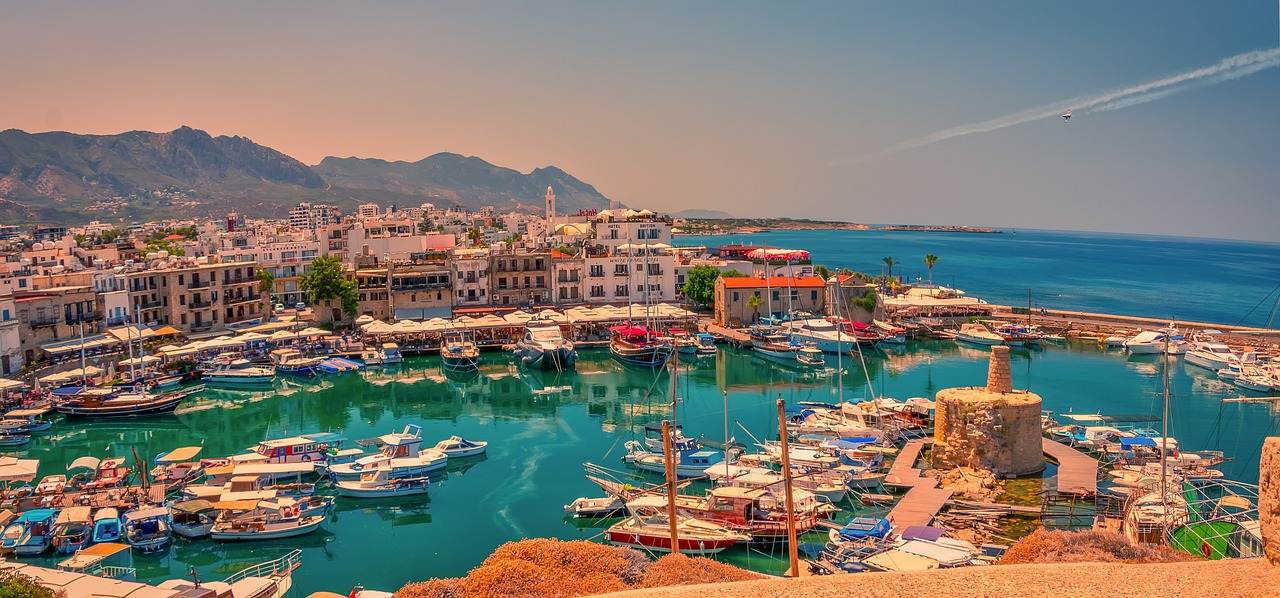
While you can survive on campus with English, the “outside world” of Nicosia, Kyrenia, and Famagusta speaks the language of the Mediterranean.
Learning Turkish in North Cyprus isn’t just about passing a module; it’s about immersion by proximity. Whether it’s negotiating at a local pazar (market), ordering a Türk Kahvesi in a harbor cafe, or navigating residency paperwork, students are constantly exposed to “Living Turkish.”
- Career Integration: As the 2026 labor market in the TRNC becomes more integrated, bilingualism is the new gold standard. Local employers increasingly seek graduates who can bridge the gap between international English-speaking clients and the Turkish-speaking local infrastructure and North Cyprus bridges the gap seamlessly.

2. A Global Village: The International Peer Effect
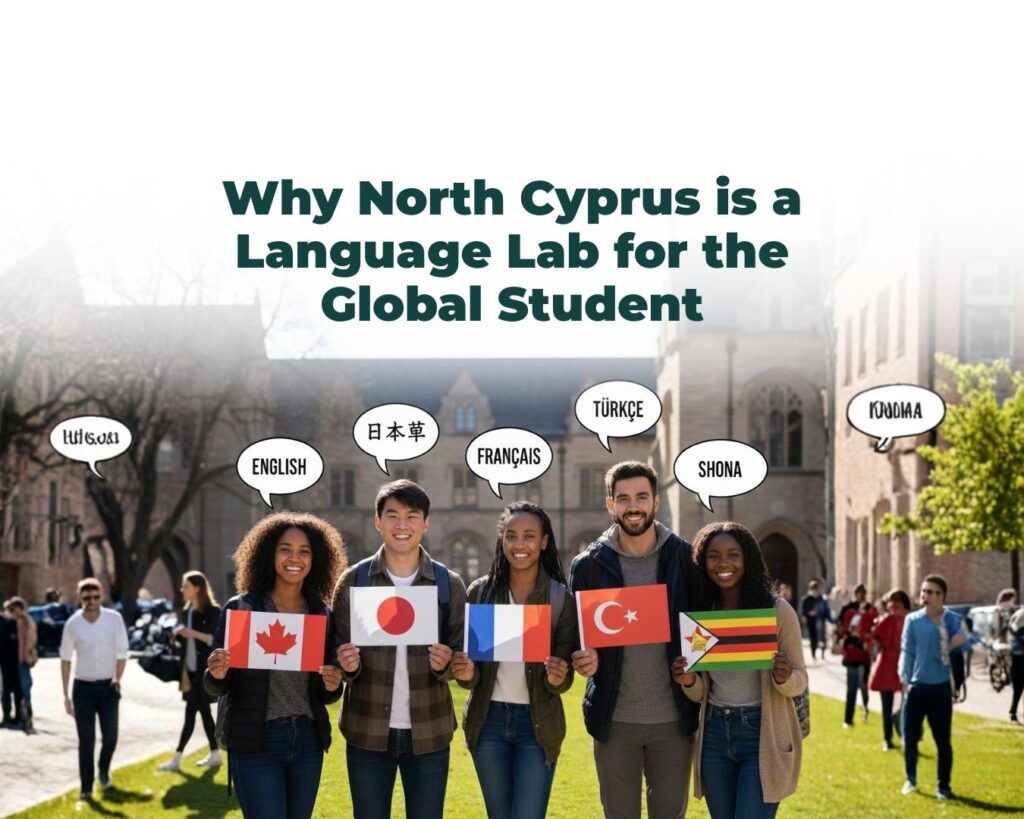
North Cyprus is one of the few places on earth where you can walk across a single campus and hear a dozen different languages in ten minutes. With students from over 110 nations, the island has become a microcosm of the world.
Because of this unique density, students aren’t just learning the local language—they are learning from each other:
- The Francophone Influence: With a massive student population from West and North Africa, French has become a prominent “third language” on many campuses. It is common to see study groups where English-taught engineering is discussed in French.
- The Slavic Connection: The island’s strong ties to Eastern Europe mean that Russian is widely heard, particularly in the tourism and tech sectors of Kyrenia.
- Arabic and Beyond: The presence of a large Middle Eastern student body ensures that Arabic is a staple of the campus soundscape, alongside Persian, Urdu, and Swahili.
3. The 2026 “Soft Power” Skill: Cultural Intelligence (CQ)
In the modern workforce, knowing a language is about more than just vocabulary; it’s about Cultural Intelligence (CQ). Studying in North Cyprus forces a student to develop a “polyglot mindset.” Even if a student doesn’t become fluent in five languages, they learn how to navigate a multilingual environment—a skill that is highly prized by global recruiters in 2026. This “Language Advantage” allows students to develop:
- Adaptability: The ability to switch communication styles based on the listener.
- Global Networking: Building a contact list that spans continents before even graduating.
- Empathy: Understanding the nuances of different cultures through their linguistic expressions.

The Degree is Only Half the Story
If you come to North Cyprus only for the English-taught degree, you are only getting 50% of the value. The other 50% lies in the “Language Lab” that exists outside the classroom.
Whether you are mastering Turkish for the local job market, practicing your French with a classmate from Senegal, or picking up Russian phrases in the harbor, North Cyprus offers a rare opportunity to graduate not just with a diploma, but with a global tongue.